Home / Protocols and Standards
Why TCP/IP Mattered: How a Common Protocol Family Connected Separate Networks

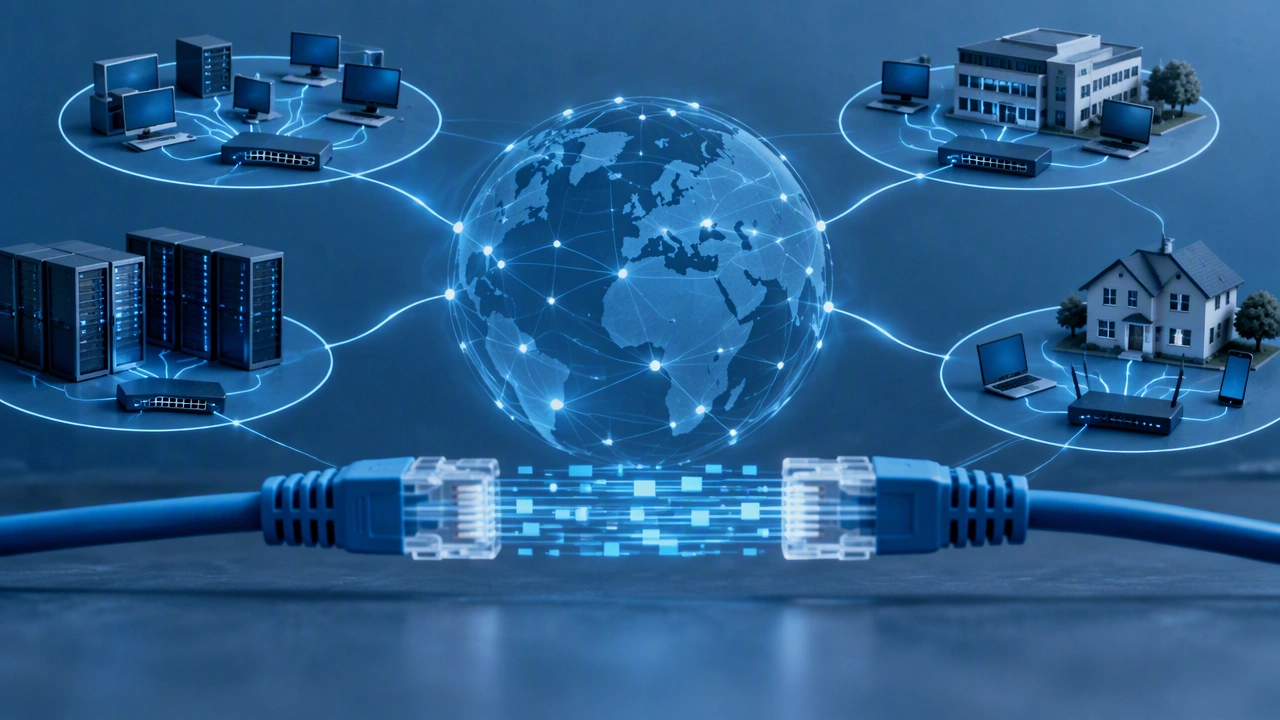
Internet history is often told as a story of faster computers and thicker cables, but the most important breakthrough was invisible. The internet did not develop as a single, centrally planned network. It developed as a way to connect many different networks that already existed, using a common protocol family that could act as a shared language. That family was TCP/IP, and its design is the reason separate systems could finally work together.
To understand why did TCP/IP replace earlier network protocols and connect separate systems, it helps to look at the networking landscape of the early 1970s. Computer networks worked, but they worked in isolation. Each network had its own assumptions about hardware, transmission methods, and software. TCP/IP succeeded because it was not designed to be the best protocol for one network. It was designed to be good enough to connect all of them.
The Early Landscape: Many Networks, No Common Language
In the late 1960s and early 1970s, packet switching had been proven practical by ARPANET in the United States, by the National Physical Laboratory network in the United Kingdom, and by CYCLADES in France. These were major achievements, but they were not compatible with each other. ARPANET itself used the Network Control Program, or NCP, to allow its hosts to communicate. NCP worked well when every host was on the same network and ran similar software, but it assumed a single, homogeneous network.
Other networks made different choices. Some were built for radio links where connections were noisy and intermittent. Others were built for satellite links with long delays. University networks, commercial networks, and military networks each optimized for their own environment. The result was a collection of islands. You could move data efficiently within one island, but there was no standard way to send data from one island to another without building a custom translator for every pair of networks.
Earlier protocols shared several limitations:
- Network dependence: They assumed the underlying network was reliable and uniform, so they could not handle the loss, delay, or reordering that happened when crossing different media.
- Single-network addressing: Addresses were meaningful only inside one network, with no global way to identify a destination on a different system.
- Tight coupling: Control functions were tied to the specific hardware and topology of one network, making it difficult to add new types of networks without rewriting the protocol.
As the number of networks grew, this approach did not scale. Maintaining a separate translation for every possible connection would have required an ever-increasing number of gateways, each with custom logic.
The Design Principles Behind TCP/IP
Between 1973 and 1974, Vint Cerf and Bob Kahn, building on work from the ARPANET community and influenced by ideas from CYCLADES and others, proposed a different approach. Instead of trying to make all networks look the same, they proposed a protocol family that would assume networks were different and provide a common layer on top of them. This became the Transmission Control Program, later split into the Transmission Control Protocol and the Internet Protocol, or TCP/IP.
Its strength came from a few deliberate design choices that were unusual at the time.
1. Layering and the Internet Protocol
TCP/IP separates responsibilities into layers. The Internet Protocol, or IP, handles the job of addressing and forwarding packets across networks. It is deliberately simple and connectionless. Each packet, called a datagram, is treated independently and forwarded toward its destination without requiring a pre-established circuit. IP does not guarantee delivery, order, or error correction. It simply tries its best to get the packet there. This best-effort model meant IP could run over almost any underlying network, from an Ethernet local area network to a long-distance satellite link, because it asked very little of that network.
2. End-to-End Reliability with TCP
Reliability was moved to the ends of the communication, not the middle. The Transmission Control Protocol, or TCP, runs on the sending and receiving hosts. It breaks data into segments, numbers them, retransmits lost segments, reassembles them in order, and controls the flow of data to avoid overwhelming the receiver or the network. By placing these functions at the endpoints, the core of the network could remain simple and fast. Intermediate gateways, later called routers, did not need to keep detailed state about every connection passing through them.
3. Open Architecture and the Gateway Concept
Perhaps the most important principle was open architecture. TCP/IP made no assumptions about what a network looked like internally. It only required that each network could carry an IP packet and that a gateway could translate between the network’s local format and the IP format. This made it possible to interconnect networks without changing their internal design. A university running one type of hardware and a research lab running another could both join the same internet by implementing IP at their edge.
Why Earlier Protocols Could Not Scale
NCP, which TCP/IP replaced on ARPANET, illustrates the difference clearly. NCP assumed a single network with a single address space and reliable underlying links. It could not address a host outside ARPANET, and it controlled flow in a way that depended on the specific behavior of the ARPANET Interface Message Processors. When researchers tried to connect ARPANET to packet radio and satellite networks, NCP had no way to handle the very different error rates and latencies.
TCP/IP solved these problems by design:
- Global addressing: IP introduced a uniform address format that was independent of any single network. Every host could be identified by an IP address, allowing routers to forward packets across multiple hops without understanding the details of each network along the way.
- Fragmentation and reassembly: If a packet was too large for a particular network, gateways could fragment it into smaller pieces and have it reassembled at the destination, so networks with different maximum packet sizes could still interoperate.
- Robustness: Because TCP handled retransmission and ordering, the loss of a packet on a noisy radio link did not break the entire connection. The protocol adapted to the conditions of each path.
This generality was the key trade-off. TCP/IP was not the fastest protocol for any single network in isolation, but it was the only practical protocol for an internet composed of many different networks.
How TCP/IP Connected Separate Systems in Practice
The practical work of interconnection fell to gateways. A gateway connected to two or more networks would receive an IP packet on one network, examine its destination address, decide the next network toward that destination, and forward it. The networks themselves did not need to be changed. Only the hosts and gateways needed to understand IP.
This model was tested throughout the late 1970s in experiments linking ARPANET, packet radio, and satellite networks. The decisive moment came on January 1, 1983, known as Flag Day, when ARPANET officially switched from NCP to TCP/IP. Every host was required to use TCP/IP to remain connected. The transition was disruptive, but it proved that a diverse community could converge on a single protocol family without collapsing the network.
The adoption accelerated with the National Science Foundation Network, or NSFNET, built in the mid-1980s to connect supercomputer centers and later regional academic networks. NSFNET adopted TCP/IP as its standard and made interconnection a condition of participation. Commercial networks that wanted to exchange traffic with universities had to support TCP/IP as well. Because the protocol was openly documented and not tied to a single vendor, manufacturers could implement it on different operating systems and hardware, which further expanded its reach.
From a Research Internet to Global Infrastructure
Once TCP/IP became the common layer, innovation could happen above and below it. Below IP, new link technologies like Ethernet, token ring, fiber optics, and later wireless could be deployed without changing applications. Above IP, new protocols like the Domain Name System, the World Wide Web’s HTTP, and email’s SMTP could develop without worrying about the details of the underlying networks. This hourglass shape, with IP at the narrow waist, is what allowed the internet to grow so rapidly.
Earlier protocol families did not offer this independence. They bundled addressing, reliability, and hardware control together, so any change in one area required changes in all the others. TCP/IP’s layered design allowed each part of the system to evolve separately while still interoperating. That is why it could absorb entirely new kinds of networks, from local area networks in offices to mobile data networks decades later, without being replaced itself.
The development of the internet was therefore less about building one network to rule them all and more about agreeing on a minimal, shared set of rules that let many networks cooperate. TCP/IP provided that agreement. By replacing earlier, network-specific protocols with a family designed for interconnection, it turned a set of separate systems into a single, global system where any host could, in principle, communicate with any other.