Home / Protocols and Standards
Packet Switching: The Communication Method That Built the Internet
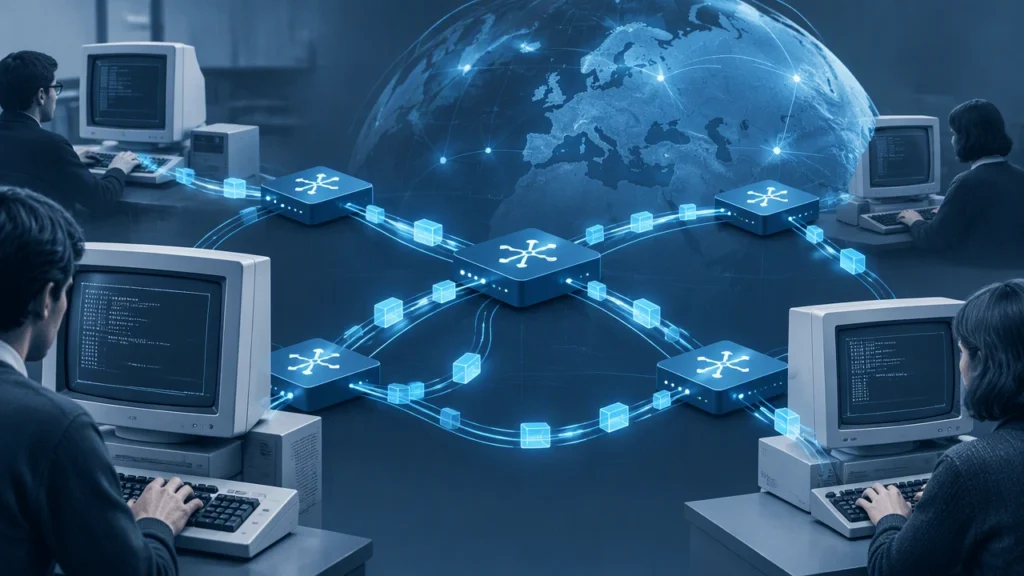
Before the internet could become a global network, engineers had to solve a basic problem: how should computers exchange data when no dedicated path between them is guaranteed to remain available? The answer was packet switching, a communication method that broke messages into small pieces and routed each piece independently. This idea became one of the foundations of modern networking and a central chapter in internet history.
What is packet switching?
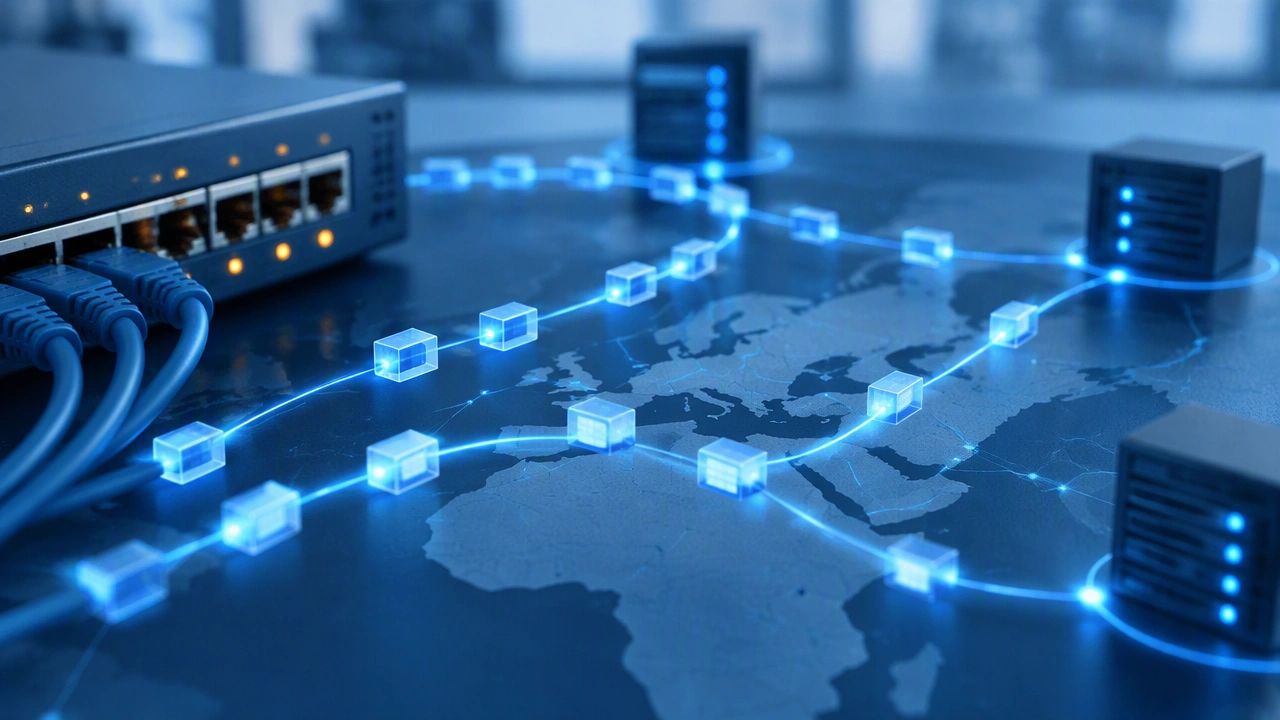
Packet switching is a way of sending digital data by dividing it into small blocks called packets. Each packet contains a portion of the original message along with addressing and control information. Instead of reserving one continuous circuit from sender to receiver, the network forwards packets hop by hop through routers and other switching devices.
Because packets carry their own destination information, each one can be routed separately. Two packets from the same message may travel different paths, encounter different delays, and arrive out of order. The receiving computer reconstructs the original message once all packets have arrived.
This approach differs from the circuit-switched systems used by traditional telephone networks. In circuit switching, a dedicated path is established for the entire conversation. The path remains reserved even when nobody is speaking, which makes efficient use of the connection difficult. Packet switching instead allows many conversations to share the same physical links by interleaving their packets.
How a message becomes packets
When an application sends data, the network software divides the data stream into segments and adds a header to each segment. The header typically includes source and destination addresses, packet identifiers, sequencing information, and protocol details. Together, these fields allow the network to forward the packet and the destination to place it back in the correct order.
At each router, the device examines the destination address, consults its forwarding information, and selects the next link. The packet is then placed into a queue for transmission. If the link is busy, the router waits or, in some cases, discards the packet when congestion becomes too severe.
The receiving system uses the sequence information to identify missing or duplicated packets. Protocols running above the network layer can request retransmission or reorder the data before presenting it to the application. This division of responsibilities is important: the network moves packets, while higher-level protocols turn those packets into reliable communication.
Why packet switching mattered for early computer networks
Early computer networks faced constraints that made dedicated circuits unattractive. Links were expensive, machines generated traffic in bursts, and many connections were idle for long periods. Packet switching addressed these constraints in several ways.
- Efficient use of links: Packets from different sources could share the same line, so capacity was allocated according to demand rather than a fixed schedule.
- Resilience: If a link failed, routers could often send later packets along another route. There was no single circuit whose failure would end the entire connection.
- Simplicity at the edges: Computers did not need to coordinate a continuous end-to-end reservation before sending data. They could transmit whenever traffic was available.
- Scalability: New networks and routes could be added without requiring every pair of computers to establish a dedicated path in advance.
These properties made packet switching especially suitable for research networks built from heterogeneous equipment and changing links. The result was a system that could grow incrementally while remaining usable.
Competing ideas and the path to the internet
Packet switching was developed during a period of intense experimentation in data communications. Two influential approaches emerged: datagram service and virtual circuits.
A datagram network treats every packet independently. Each packet is forwarded on its own, and the network does not guarantee that packets will follow the same path. The internet’s basic network layer, IP, follows this model.
A virtual circuit establishes a logical path before transmission. Packets receive labels that direct them along the same sequence of switches. This can simplify ordering and resource management, but it introduces more state into the network.
Early projects such as ARPANET demonstrated that packet-switched communication could connect computers reliably. As research expanded, different packet networks used different rules for addressing, framing, and delivery. Connecting those networks required a common method of carrying packets across their boundaries. The resulting internetworking protocol allowed separate packet networks to exchange traffic while preserving their internal designs.
What packet switching enabled
Packet switching made the internet flexible enough to support services that were not imagined when its earliest links were built. Because applications simply exchange packets, the same infrastructure can carry email, web pages, video, software updates, and real-time audio without requiring a separate network for each use.
The model also enabled graceful growth. Traffic expands and contracts unpredictably, and different applications have different needs. Packet networks respond by buffering, forwarding, prioritizing, or dropping packets according to configured policies. This flexibility is imperfect, but it avoids the rigid capacity planning required by dedicated circuits.
Most importantly, packet switching separated the task of moving data from the task of interpreting it. The network does not need to understand the content of a message; it only needs to deliver packets to the correct destination. That simple boundary allowed protocols and applications to evolve independently.
Trade-offs that remain visible today
The method introduced costs as well as benefits. Independent routing can produce variable delay, because packets may encounter different levels of congestion. Out-of-order delivery requires additional processing. Heavy traffic can lead to bufferbloat, packet loss, and retransmissions. Security is also more complex, since routers must process headers from many sources and network operators must manage trust across multiple domains.
These challenges are not failures of the original idea. They are consequences of building a shared, decentralized system. Engineers have added congestion control, quality-of-service mechanisms, encryption, and more sophisticated routing to manage them while retaining the flexibility of packet delivery.
The lasting significance
Packet switching turned communication into a distributed process. Instead of holding one path open from beginning to end, it allowed messages to move as independent units that could be routed around problems and shared with other traffic. That design gave early computer networks the efficiency and resilience they needed, and it provided a foundation on which later protocols and applications could be built.
The internet continues to change, but its central habit remains recognizable: data is divided, addressed, forwarded, and reassembled. Understanding packet switching explains not only how messages travel, but why the internet was able to grow from specialized research connections into a general-purpose global network.