Home / Access and Infrastructure
Role of Undersea Cables: Why Physical Seabed Lines Still Carry Most International Internet Traffic
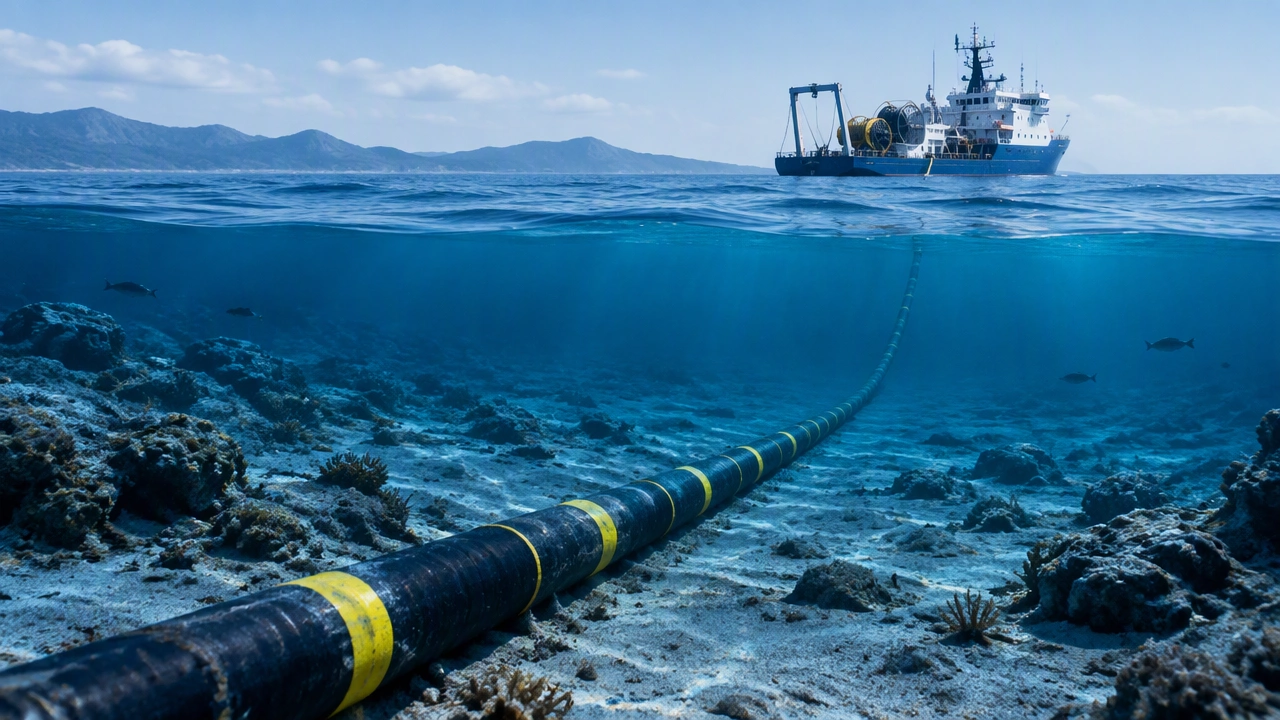
The global internet often feels like an invisible force, yet its most critical links are physical: thousands of kilometers of undersea cables laid across ocean floors. Despite the rise of satellites and wireless technologies, these seabed lines still carry the vast majority of international internet traffic. Understanding why requires looking at how the internet developed, how data moves between continents, and what engineering trade-offs shape modern networks.
How the internet grew around submarine cables
In the early days of internet history, international connectivity depended on specialized lines and shared links. As demand expanded in the 1990s and 2000s, submarine cable projects multiplied, creating dense routes across the Atlantic, Pacific, and Indian Oceans. Each new cable increased capacity and reduced latency, making cross-border services practical for businesses and consumers. Today, most traffic between North America and Europe, or between Asia and the Americas, travels through fiber-optic cables hidden beneath the sea.
These cables are not a relic; they are the backbone of a system optimized for performance and scale. A single modern submarine cable can carry tens of terabits per second, and multiple cables provide redundancy along key corridors. That combination of capacity and resilience is difficult to match with current satellite constellations, especially when considering the density of traffic between major economic regions.
How do undersea cables carry internet traffic between continents?
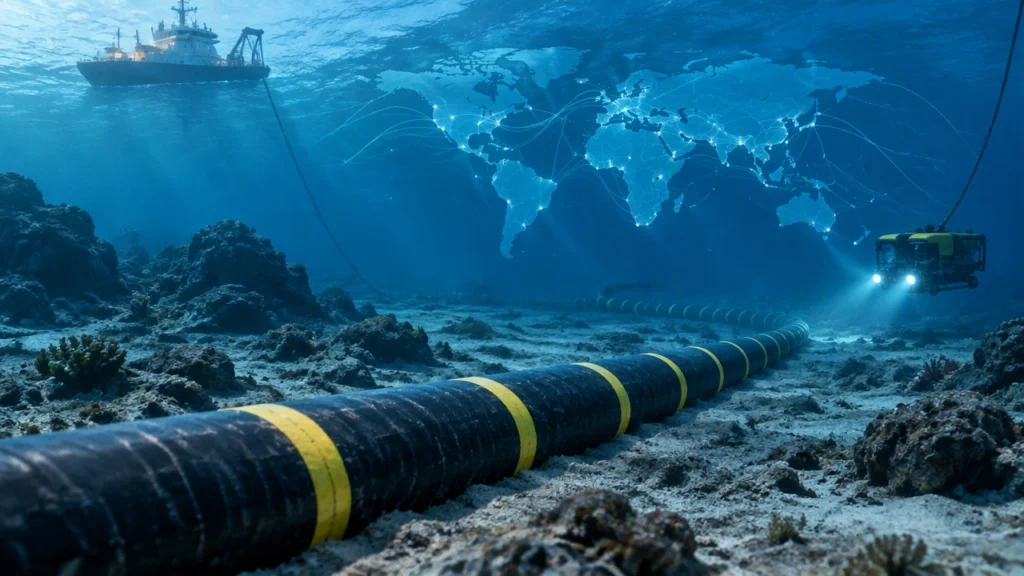
Undersea cables carry internet traffic between continents by converting digital data into pulses of light and sending those pulses through thin glass fibers. At landing stations on each shore, equipment translates these optical signals into formats that connect with terrestrial networks. Repeaters placed along the route boost the light so it can travel long distances without losing clarity. The result is a continuous, high-capacity pathway that moves data faster and more efficiently than most alternatives.
The physics of light in fiber gives submarine cables a strong advantage. Light can travel long distances with low loss, and multiple wavelengths can be sent simultaneously through a technique called wavelength-division multiplexing. That means a single fiber pair can carry many channels at once, dramatically increasing total capacity. Because the signals are confined within the fiber, they are also less susceptible to interference compared with radio-based systems in many environments.
Why seabed cables beat satellites for most traffic
When people ask why satellites do not replace cables, the answer lies in trade-offs. Geostationary satellites have high latency because signals must travel to orbit and back, creating noticeable delays for interactive applications. Low Earth orbit constellations reduce latency, but they still face constraints in total capacity and coverage compared with dense cable routes. Cables, by contrast, provide consistent throughput and lower latency along high-demand paths.
Cost per bit is another factor. Submarine cables are expensive to build and maintain, but their capacity is enormous, which drives down the cost of moving data at scale. For service providers and enterprises that need predictable performance between continents, cables remain the most economical and reliable option.
Capacity and reliability
Cable systems are designed with redundancy and diverse paths. If one cable experiences a fault, traffic can be rerouted through other systems. This approach supports stability even during maintenance or unexpected incidents. Modern cables also include monitoring tools that help operators detect issues quickly and coordinate repairs with specialized ships.
Latency and consistency
Latency matters for video calls, financial transactions, cloud applications, and online gaming. Submarine cables offer consistent latency because the path is fixed and optimized. Wireless systems can be affected by weather, congestion, and orbital dynamics, which can introduce variability. For many services, consistency is as important as raw speed.
The journey from shore to shore
A submarine cable project starts with route surveys that map the ocean floor and identify safe corridors. Engineers avoid hazards where possible, and they plan burial or protection in shallow waters where anchors or fishing gear pose risks. After manufacturing and loading, a cable-laying ship pays out the cable along the planned route, while teams on shore prepare landing stations and terrestrial connections.
Once operational, cables link to national and regional networks, then to data centers and end users. This end-to-end chain explains why the performance of international internet services depends not only on the cable itself, but also on how well each segment is engineered and managed.
Where satellites fit in
Satellites play a valuable role where cables are impractical. Remote islands, ships, aircraft, and rural regions often rely on satellite links for connectivity. In disaster recovery scenarios, satellites can restore communication quickly while cable repairs are underway. As constellations grow, they will complement cables by extending access and providing alternative paths, but they are unlikely to replace cables for the bulk of international traffic in the near term.
Future trends and ongoing challenges
The next generation of submarine cables will continue to increase capacity through improved fiber design and more efficient transceivers. New routes will enhance resilience and reduce dependence on congested corridors. At the same time, operators face environmental and regulatory challenges, including marine protection, permitting, and coordination with fishing and shipping industries. These factors shape where and how cables can be deployed.
Security remains a priority as well. Physical protection, monitoring, and international cooperation help reduce risks. As more services depend on global connectivity, the importance of well-maintained, diversified cable infrastructure grows.
Why cables remain central to the internet
Physical seabed cables still carry most international internet traffic because they deliver a rare combination of high capacity, low latency, and predictable performance. They were foundational to how the internet developed, and they continue to anchor the global network today. While satellites and wireless systems expand access and add flexibility, cables provide the heavy lifting between continents.
For anyone wondering how do undersea cables carry internet traffic between continents, the answer is straightforward: they convert data into light, send it through carefully engineered fiber paths, and connect shore stations to the wider internet. That simple principle, refined over decades, explains why these hidden lines remain the most important infrastructure for international connectivity.