Home / Origins and Foundations
Internet History: How the First ARPANET Connections Worked in 1969
How did the first ARPANET connections work in 1969? This question sits at the heart of internet history because those early links turned an ambitious research idea into a working system. In the late 1960s, universities and government labs had new time-sharing computers, but each machine was isolated. Researchers who wanted to run programs or access data on another computer had to ship tapes, share punch cards, or travel. That friction slowed progress across the growing U.S. scientific community.
At the same time, the Advanced Research Projects Agency (ARPA) was funding many different computing projects at universities and labs across the country. The more those projects grew, the more obvious it became that they needed a shared way to communicate. A network could let researchers use specialized tools and data sets without building everything from scratch at every site. The problem was not just convenience; it was about making scarce, expensive computing resources available to more people and about keeping research collaboration moving as projects became more complex.
The research problem ARPANET was built to solve
Before ARPANET, each time-sharing system spoke its own language, and links between sites were usually slow, special-purpose, or not interactive. If a lab at one university had a unique simulation tool, a researcher at another university often could not use it in real time. This created duplication of effort, uneven access, and delays in scientific work.
ARPA’s vision was a resource-sharing network that could connect heterogeneous computers across long distances. The goal was not simply to send messages, like a better telephone system, but to let a user on one machine log in to another machine, transfer files, and run programs remotely. That shift from point-to-point communication to a general-purpose computer network was the core problem ARPANET set out to solve.
Packet switching: the technical idea behind the network
To build a network that could survive partial failures and serve many users at once, ARPANET adopted packet switching. Instead of reserving a dedicated circuit for each conversation, the network broke messages into small packets, sent them independently through the system, and reassembled them at the destination. Each packet carried addressing information and could be routed through different paths if congestion or faults appeared.
This idea had been explored in several research settings in the 1960s, and ARPA brought it into a wide-area operational network. The approach made better use of existing communication lines, allowed multiple conversations to share the same infrastructure, and provided a more resilient design than traditional telephone-style switching.
Interface Message Processors: the first routers
At each site, a dedicated minicomputer called an Interface Message Processor (IMP) handled the networking work. The IMP took packets from the host computer, forwarded them across the network, and delivered incoming packets to the right host. By separating the communication task from the host computer, the IMPs let many different types of machines join the network without requiring each one to implement every networking detail.
IMPs were connected by leased telephone lines. They used reliable point-to-point links between neighbors and ran protocols to detect errors, request retransmissions, and manage flow. This design created a small mesh of IMPs that could route traffic around problems and keep data moving even if one link failed.
How the first connections came together in 1969
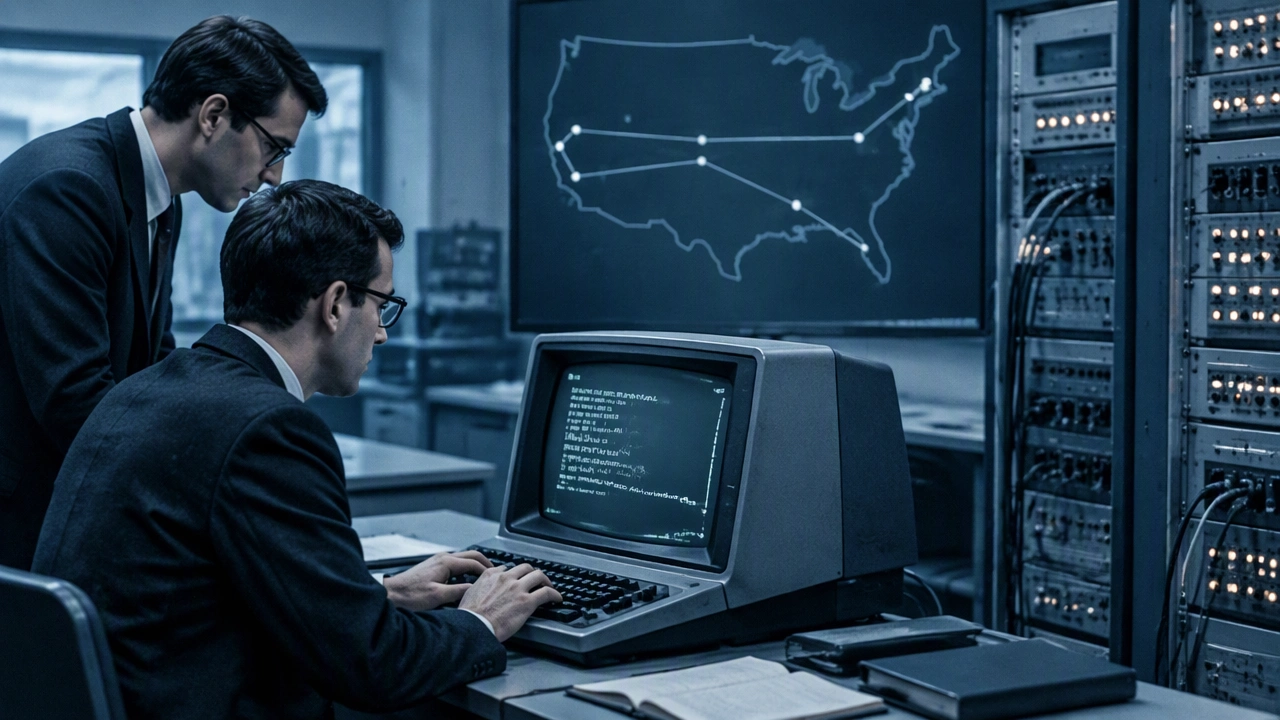
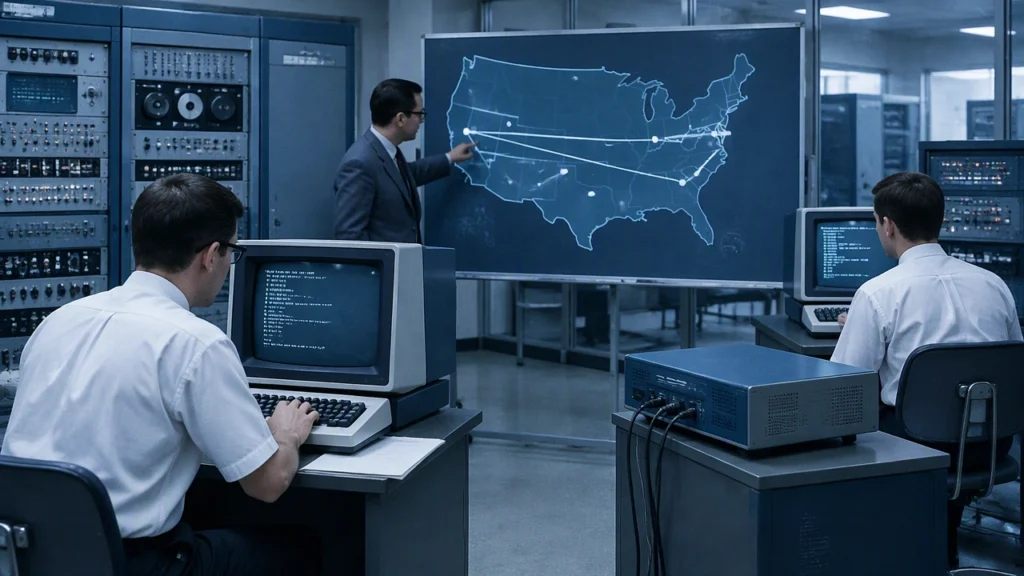
The first four sites were the University of California, Los Angeles (UCLA); the Stanford Research Institute (SRI); the University of California, Santa Barbara (UCSB); and the University of Utah. Each site received an IMP and connected it to its local computer. Technicians tested the hardware and software carefully before attempting end-to-end communication.
The earliest host-to-host connection was made between UCLA and SRI. The plan was simple: a user at UCLA would log in to the SRI machine and run a basic command. The first attempt to send the word “LOGIN” famously stopped after the letters “L” and “O” when the system crashed. After fixes, the full login succeeded, and the network had proven that a user could reach another computer across the country through the IMP system.
Soon after, the team added UCSB and Utah. Researchers began testing remote logins, file transfers, and simple applications. These early trials were modest, but they showed that the network could support real work. Each new connection increased confidence that a shared infrastructure could serve a broad research community.
What the first ARPANET connections actually did
The first connections focused on tasks that matched the original goal of resource sharing. Users could log in to a remote machine, move data between sites, and access software that was not available locally. This made it possible to collaborate across campuses without shipping physical media or traveling long distances.
Even at this early stage, the network supported more than one type of activity. In addition to interactive login and file transfer, simple application experiments began to appear. As the community grew, these experiments pointed toward new uses that went beyond the original plan.
Early milestones that followed the first links
After the initial four nodes, more universities and labs joined the network. By the early 1970s, ARPANET connected sites across the United States and extended to Hawaii and overseas locations through satellite and other links. This expansion showed that the architecture could scale and adapt to new environments.
A major step came in 1971 with the development of email on ARPANET. Electronic mail quickly became one of the most popular applications because it solved a simple, everyday problem: people wanted to send notes and files to each other. That practical use helped drive adoption and demonstrated that networks could support social and organizational communication, not just raw computing tasks.
Protocols, standards, and the path to the modern internet
The first ARPANET connections relied on early protocols for host-to-host communication. As the network grew, researchers developed more robust and general protocols. Work on network interconnection led to the concept of a “network of networks,” and eventually to the Transmission Control Protocol and Internet Protocol (TCP/IP). On January 1, 1983, ARPANET sites transitioned to TCP/IP in a coordinated switch that is often cited as a key moment in the birth of the modern internet.
These standards allowed different networks to interoperate. That interoperability was essential for growth beyond a single research network. It enabled universities, government agencies, and later commercial organizations to connect their systems while keeping their internal networks independent.
Why the 1969 connections matter today
The first ARPANET connections in 1969 mattered because they proved a simple but powerful idea: geographically separated computers could share resources through a common packet-switched infrastructure. The project solved a real research problem by giving scientists and engineers a practical way to collaborate and access tools remotely.
From those first four nodes grew a global system that supports communication, commerce, education, and culture. The IMPs are gone, the speeds are vastly higher, and the protocols have evolved, but the core insight remains. ARPANET showed that building a resilient, open network for sharing computing resources could change how people work and learn. That is why the story of those first connections is still central to internet history.