Home / Access and Infrastructure
From Dial-Up to Broadband: How Always-On Connections Changed Home Internet Use

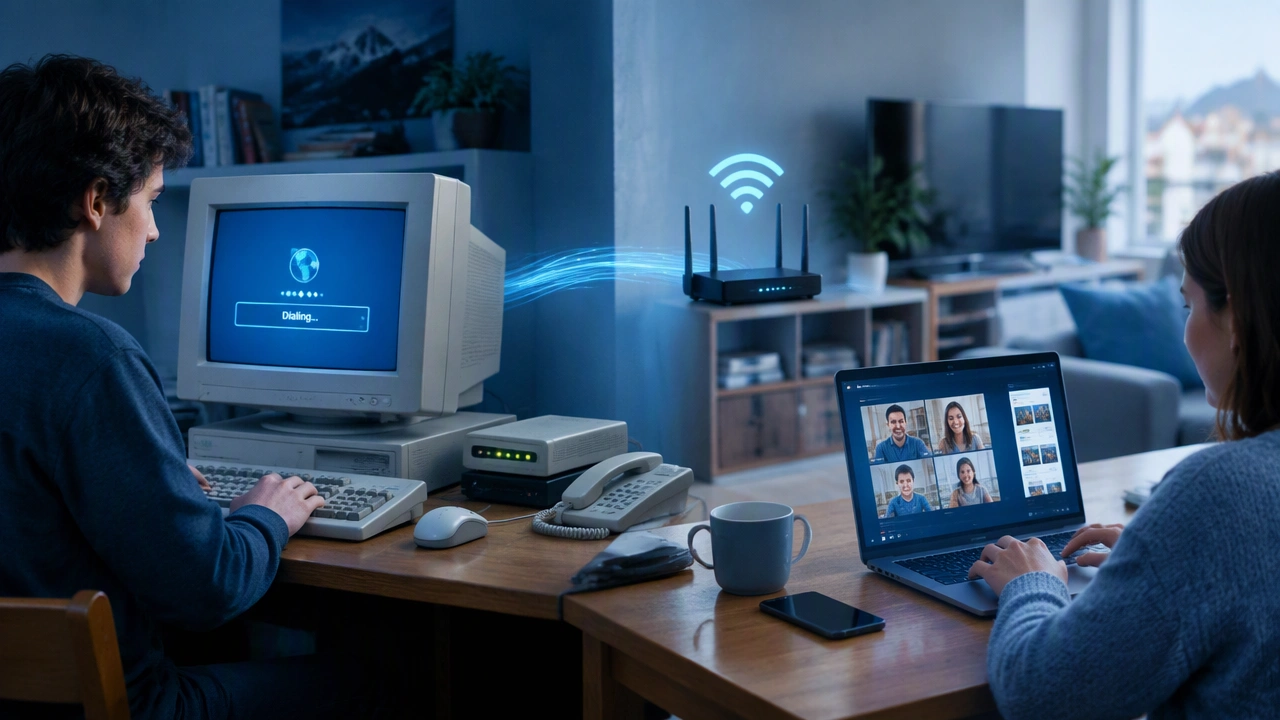
The sound of a modem negotiating a connection, followed by the warning not to pick up the phone, was once a familiar start to going online. For most households in the 1990s, the internet was a temporary state, not a constant background utility. You dialed in, you did what you needed to do, and you disconnected. A decade later, that experience had been almost completely replaced. To understand this transition is to understand a turning point in internet history, and it helps to ask a simple question: What changed when households moved from dial-up internet to broadband? The answer involves both technical infrastructure and the quiet, everyday shifts in how people used the internet at home.
How Dial-Up Worked: A Temporary Connection Over Telephone Lines
Dial-up internet worked by borrowing infrastructure that was never designed for data. A modem, short for modulator-demodulator, converted digital signals from a computer into analog tones that could travel over a standard copper telephone line. At the other end, equipment at the internet service provider converted those tones back into digital data. Because it used the voice network, the connection was circuit-switched, meaning it established a dedicated, temporary circuit between your home and the provider for the duration of the call. The theoretical maximum under the last dial-up standard was 56 kilobits per second downstream, and often less in practice due to line quality. If someone picked up another phone extension, the noise could drop the connection. And because the line was occupied, you could not receive voice calls while online unless you had a second line.
What Everyday Life Was Like on Dial-Up
The technical limits shaped daily habits. Going online was an intentional act. You double-clicked a connection icon, listened to the dial tone and handshake, and waited 30 to 60 seconds to be authenticated. If the line was busy, you tried again. Once connected, everything felt sequential and fragile. A single large image could take half a minute to load, so people disabled images in browsers to save time. Downloading a 5-megabyte song could take more than an hour, and an incoming call could interrupt it. Families negotiated internet time. Parents set limits because many providers charged by the hour and phone companies charged for local calls in some regions. The computer was usually in a shared room, and being online meant being unavailable by phone, which created constant, low-level tension in households with one line.
How Broadband Changed the Technical Foundation
Broadband did not just make the same connection faster; it changed how the connection was built. The term broadband originally referred to a wider range of frequencies, but for households it came to mean a high-speed, always-on link that did not interfere with telephone service. Two early forms dominated: digital subscriber line, which used higher frequencies on the same copper pair, and cable internet, which used the coaxial network built for television. Both kept data and voice separate, so the internet no longer needed to dial a phone number.
Always-On and Packet-Switched
Instead of a switched circuit, broadband provided a persistent packet-switched connection. Your modem or router stayed synchronized with equipment at the telephone exchange or cable headend, maintaining a link even when you were not actively loading a page. An always-on connection meant no dialing, no handshake delay, and no busy signal. It also meant the connection had its own address assignment that could persist for hours or days, which made it practical to leave devices connected and to share one connection among several computers through a router.
More Bandwidth and Different Performance
Speed was the most obvious difference, but consistency mattered too. Early consumer broadband typically offered 256 kilobits to 2 megabits per second, several times faster than dial-up, and later generations moved to tens and hundreds of megabits. More importantly, bandwidth was symmetrical enough for two-way use and was not degraded by voice traffic. Latency, the time for a small packet to make a round trip, dropped from hundreds of milliseconds on dial-up to tens of milliseconds, which made interactive uses like online gaming and voice calls feasible. Broadband connections were also designed to stay up, with error correction and better shielding, so long downloads could complete without redialing.
What Changed at Home When Connections Stayed On
The shift to an always-on link changed behavior more than any single speed increase. The internet stopped being an activity you started and stopped and became an environment that was simply present.
- No dialing or waiting: Computers could go online instantly, which made quick lookups practical for the first time.
- Phone and internet together: Households no longer had to choose between a call and a connection, removing a major source of friction.
- Shared access: A single broadband line with a router and later Wi-Fi allowed several family members to be online at once, on different devices.
- New kinds of content: Streaming audio and video, large photo uploads, software updates, and later video calls became usable without planning around connection time.
- Background use: Email could be checked automatically, antivirus definitions could update quietly, and devices could stay connected overnight.
These changes were subtle at first but cumulative. Where dial-up encouraged focused, task-oriented sessions, broadband encouraged frequent, short interactions and longer periods of passive connection. Children could do homework research without blocking the family phone, and parents could shop or bank online without watching the clock. The home computer moved from a shared desk to multiple devices throughout the house, a shift made possible because the connection no longer belonged to a single computer or a single phone call.
Why This Transition Still Matters
The move from dial-up to broadband did more than improve convenience; it allowed the modern internet to emerge. Services that assume a persistent connection, such as cloud storage, automatic backups, video conferencing, and smart home devices, would not be practical on a line that must be dialed and that drops when the phone rings. The always-on model also changed expectations around availability. People began to expect that information, messages, and entertainment would be reachable without setup, which in turn encouraged developers to build richer, more interactive websites that assumed higher bandwidth and lower latency. In that sense, broadband did not just speed up the old internet; it made a different kind of internet possible at home.